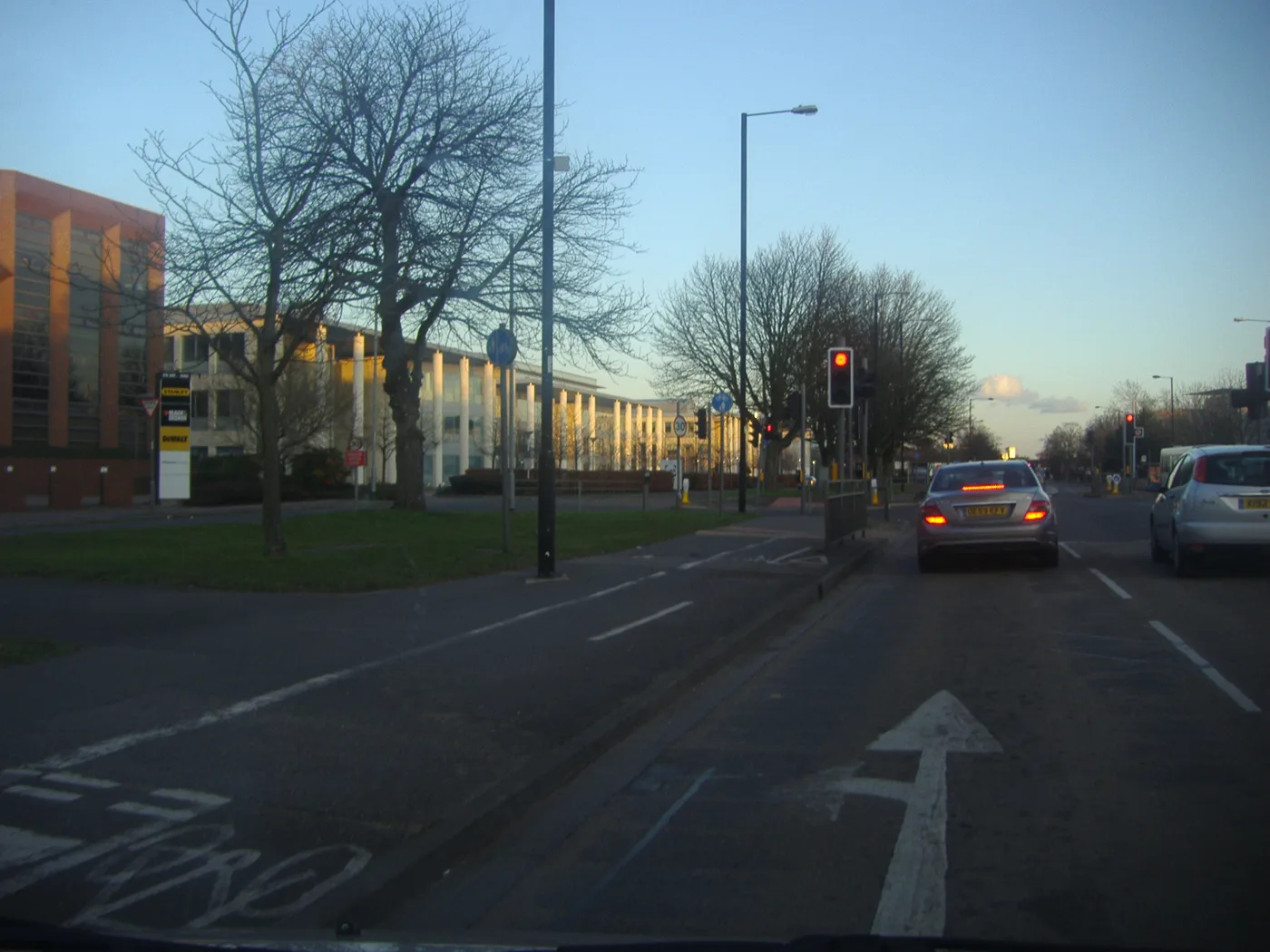

A 2024 safety audit of Slough's A4 cycle lane urged a 30mph limit and a signalised St Andrew's Way crossing. The council disclosed it on 23 November.
The independent road safety audit of Slough’s £10.4m A4 cycle lane recommended cutting the Bath Road speed limit from 40mph to 30mph. It also asked for a signalised crossing at St Andrew’s Way, where works are due to finish in December. Slough Borough Council disclosed the September 2024 audit on 23 November, in answer to a resident’s request under the Environmental Information Regulations.
Overview
- What: the Stage 1/2 Road Safety Audit of the Bath Road cycleway, phases 1, 2 and 3, dated 18 September 2024 and prepared by Mayer Brown for the council.
- Main points: a 30mph limit on the A4, a signalised crossing at St Andrew’s Way, and a warning that a crossing on Goldsworthy Way could back traffic onto the roundabout.
- Not released: what the designers did with the recommendations. The resident says they have asked for it.
- On site: the council says Huntercombe Lane crossroads to Goldsworthy Way is complete, and Goldsworthy Way to St Andrew’s Way and the St Andrew’s Way junction are due in December 2026.
The resident is the same Slough road user whose questions led to our September report on the police warnings about the old A4 bus lane. They asked not to be named. They put the stakes this way:
The issue is not simply the disruption caused by the works, but whether the identified safety concerns were addressed, how public funding and project changes have been managed, and whether sufficient information is being made available for public scrutiny.
What the auditors found
The audit was carried out on the scheme drawings, with a site visit on 27 September 2024. The audit team says it looked only at road safety, not at whether the design met other standards. It also says eight issues raised in a November 2023 audit of phase 2 “remain an issue” and were repeated.
Two findings sit on the stretch now being finished at the western end of the A4.
At St Andrew’s Way, the auditors found that an existing uncontrolled crossing “on the east-west desire line near Bath Road has been omitted as part of the proposals”. They wrote:
This is considered a retrograde step in road safety terms, as pedestrians crossing St Andrews Way on the desire line could trip on a full height kerb, and no tactile paving has been provided to guide vision impaired users across St Andrews Way.
They recommended a signalised crossing on that line, included in the phasing of the neighbouring traffic lights.
At Goldsworthy Way, the concern was a parallel crossing close to the roundabout on the A4 Bath Road. Northbound traffic leaving the roundabout would have to give way to people on foot and on bikes, and the auditors said this “may result in queuing traffic back on to the circulatory carriageway, especially during peak times”. That, they said, could lead to late braking and rear shunt collisions. Their advice was to move the crossing further north if there was not enough room for queuing traffic, or to make it an uncontrolled crossing.
The 30mph recommendation applies across all three phases. The auditors described the A4 Bath Road as “a busy 40mph road”. Under the Highway Code, drivers turning off it should give way to people crossing the side road. The auditors feared a driver turning left might brake hard to a stop and be hit from behind:
It is recommended that the existing 40mph speed limit is reduced to 30mph, to reduce the severity of injuries sustained in this type of collision.
Other points in the audit include:
- footways in places under 2m wide, and some “less than 1.5m”, which the auditors expected to push people on foot and on mobility scooters into the cycle lane
- bus stops east of Station Road and on Farnham Road near Salt Hill Drive, where waiting and alighting passengers would be likely to step into the cycle lane
- a junction at Bath Road and Station Road that may be too tight for lorries turning left, since no swept path drawings were supplied
- no signal timings or queue lengths supplied, so the auditors could not judge queuing at the new lights
- one-way cycle lanes on Bath Road near Cippenham and on Cippenham Lane, where the auditors warned of cyclists riding against the flow
- drainage, tactile paving and kerb details along the whole route
What the council disclosed, and what it did not
The council’s reply, sent on 23 November after an internal review of the request, answers 21 numbered questions. It attaches two documents: the audit and the Department for Transport grant letter.
| Question | The council’s answer |
|---|---|
| Huntercombe Lane crossroads to Goldsworthy Way | “Works complete” |
| Goldsworthy Way to St Andrew’s Way | December 2026 |
| St Andrew’s Way junction | December 2026 |
| Why lanes stayed coned off with no work under way | “unforeseen site conditions / underground utilities requiring revised designs and curing requirements of concrete” |
| Complaints since January 2026 | 17: seven complaints and ten enquiries |
| Contractor site diaries and progress reports | Not held: they “belong to the contractor and not SBC” |
| Monitoring of queues, journey times and congestion during the works | Not held |
| Air quality assessment of the works | Not held |
| Programme changes, signal and lane closure approvals, budget, contract variations | Withheld as “commercially and operationally sensitive” |
The council said identifying each change to the programme, with its reason, “would require approximately 3 hours of officers’ time”. It cited regulations 12(5)(d) and 12(5)(e) of the Environmental Information Regulations for the information it held back.
It did explain why the cost grew. The scheme was costed at concept stage at about £2m to £2.5m, according to December 2020 Cabinet records cited in the request. The council said that estimate “did not take into account”:
- statutory undertaker diversions
- the final design of major junction improvements
- inflation
- risk
The complaints were about traffic, the reasons for the works, delays, and objections to the works, the council said. It holds no summary or report on them.
The grant conditions
The Department for Transport’s award letter is dated 18 March 2022. It lists eight A4 sections from Huntercombe Lane to Uxbridge Road, eastbound and westbound, worth £10,199,500.
Its conditions include:
- any material change should be reported to the department and Active Travel England
- schemes costing more than £2m need their own monitoring and evaluation process, sent to the department “for review prior to the start of construction”
- monitoring reports on outputs and effects at completion, and at 6 and 12 months after the opening of the majority of schemes
- changes to designs, spending or timelines to go through a change control request “agreed in advance of changes”
- the council “accepts responsibility for meeting any costs over and above DfT’s contribution”, including potential cost overruns
If the council fails to meet the terms, the memorandum attached to the letter says the Secretary of State may reduce or withhold future payments, or require “the repayment of the whole or any part of the grant”. The council withheld its records of programme changes and contract variations, so it is not possible to see from the reply what was reported to the department.
The resident said:
The grant conditions make it particularly relevant to establish what change-control records, approvals and monitoring reports exist and how the scheme’s delivery has been overseen.
How the request was handled
The request went in on 1 September 2026. The ordinary 20 working day deadline passed on 29 September. On 2 October the council refused it under section 12 of the Freedom of Information Act, saying the cost of finding the information would exceed the appropriate limit. The resident challenged that on the grounds that the request was made under the Environmental Information Regulations, which have no such cost limit.
The 23 November reply is the outcome of that review. In it the council said:
Following a review of the original response, further clarification has been identified regarding the application of the relevant legislative framework. Additional guidance and training will be provided to support consistent handling of future requests.
The resident says the reply still does not set out which exception applies to each withheld item, or the public interest test behind it. They have made further representations within the same review.
If you use the A4 at Cippenham
The council lists its permits for the works on one.network, where planned closures and diversions can also be checked. Its A4 cycle lane page carries the scheme updates. Our Slough roadworks and travel page covers the rest of the borough.
Photographs or short clips of the works at St Andrew’s Way or Goldsworthy Way are welcome at hello@sloughdaily.co.uk, with a name for the credit or none.
Sources
- Slough Borough Council, reply to EIR 344798 (internal review 345615), 23 November 2026, supplied by the requester
- Mayer Brown, Proposed Bath Road Cycleway Phases 1, 2 and 3, Stage 1/2 Road Safety Audit, 18 September 2024, disclosed by the council
- Department for Transport, Active Travel Capital Funding grant award letter No 31/6014, 18 March 2022, disclosed by the council
- Significant Decision, A4 Cycle Lane
- A4 Cycle Lane traffic order
- Cabinet decision and equality assessment
Source: Slough Borough Council, in reply to a resident’s request under the Environmental Information Regulations.
Have your say